Tell us about the job
Takes about a minute. No obligation.
Sizing a furnace for Waldo County starts with understanding what the burner and heat exchanger are actually asked to carry. Homes in Waldo County, ME run heat about nine months a year, from September through May. A system that is undersized runs longer cycles to meet setpoint, and those extra cycles land on the igniter, the heat exchanger, and the blower motor every single week the season is open. A contractor quoting a new furnace here works out the correct load before specifying equipment, because an undersized box does not just struggle on the coldest nights; it accumulates wear at a rate a properly sized unit would not.
Ductwork laid down for an earlier generation of heating equipment carries assumptions about static pressure, trunk sizing, and branch runs that a modern furnace does not share. Half the homes in Waldo County, Maine were built in 1982 or earlier (2020-2024 ACS 5-year). That spread across the housing stock means a contractor sizing a new furnace here has to look at what the ducts were built to move, not just what the new unit is rated to push. Where the existing runs are undersized or poorly laid out, the installation answer changes. The electrical service matters too, but in stock of this vintage the ductwork is where the job gets decided.
What Gets Installed With a New Furnace
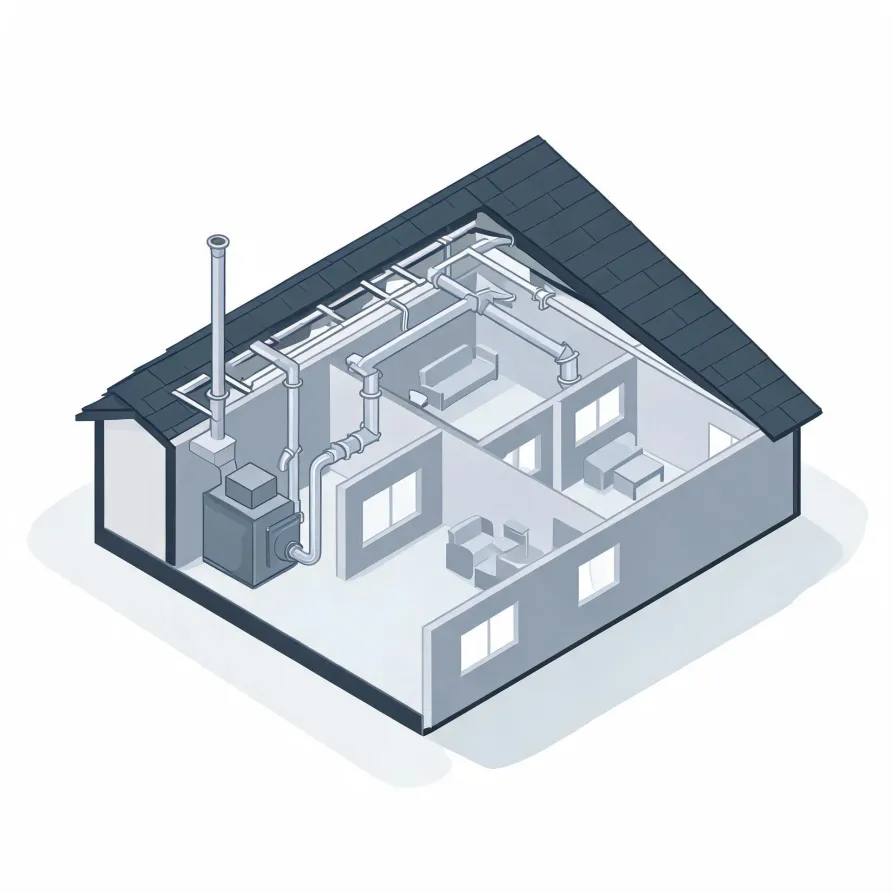
The furnace itself sits in a utility space, basement, or closet and is the heart of what gets put in. A contractor sets it in place, connects it to the fuel supply, and ties it into the home's duct system so conditioned air has a path to every room.
The air handler and blower assembly move air through that duct path each time the system runs. A thermostat goes on an interior wall where it can read the home's actual temperature and tell the furnace when to fire.
The drawing beside this text shows the general layout of a forced air furnace system, and a licensed contractor determines exactly what applies to your house.
Find a contractor in Waldo CountyWaldo County, by the numbers
120 severe weather events were recorded in Waldo County, Maine between 2015 and 2024.
NOAA National Centers for Environmental Information, Storm Events Database, bulk CSV export, events 2015-01-01 through 2024-12-31.Half the homes in Waldo County, Maine were built in 1982 or earlier (2020-2024 ACS 5-year).
U.S. Census Bureau, 2020-2024 American Community Survey 5-Year EstimatesWaldo County, Maine holds 22,252 housing units (2020-2024 ACS 5-year).
U.S. Census Bureau, 2020-2024 American Community Survey 5-Year EstimatesOwners occupy 81.9% of the occupied homes in Waldo County, Maine (2020-2024 ACS 5-year).
U.S. Census Bureau, 2020-2024 American Community Survey 5-Year EstimatesFurnace Installation Rules & Standards for Waldo County, Maine5 sourced regulations and standards
What the Installation Actually Looks Like
Non-weatherized gas furnaces manufactured on or after November 19, 2015 must reach 80.0 percent AFUE.
Non-weatherized oil-fired furnaces manufactured on or after November 19, 2015 must reach 83.0 percent AFUE.
Mobile home gas furnaces manufactured on or after November 19, 2015 must reach 80.0 percent AFUE.
Non-weatherized gas furnaces manufactured on or after December 18, 2028 must reach 95.0 percent AFUE, up from the 80.0 percent minimum that applies to units manufactured before that date.
Licensing and Legal Requirements in Waldo County, Maine
Maine licenses the fuel-burning side of heating rather than HVAC as a trade: a Maine Fuel Board licence is required to install or service solid fuel, oil, propane or natural gas burning equipment, including pellet-fired central heating appliances. Air conditioning is not named anywhere in the chapter.
Severe Weather History in Waldo County
Heating equipment in Maine works against the full weight of what the climate delivers here, and Waldo County's weather record is part of what determines how hard that equipment has to work. A furnace sized and installed for local conditions holds up differently than one that was not.
120 severe weather events, 2015–2024. Source: NOAA National Centers for Environmental Information, Storm Events Database.