Tell us about the job
Takes about a minute. No obligation.
A furnace repair quote in Waldo County starts with the parts that cycle most: the burner, the heat exchanger, and the ignition system. Homes in Waldo County, ME run heat about nine months a year, from September through May. That kind of continuous seasonal demand accumulates on the components that fire and shut down repeatedly, and a contractor inspecting a furnace here finds wear on those parts first. Cracks in the heat exchanger and ignition failures are not random; they follow the load the equipment has been carrying year after year.
Ductwork in a house this old was sized and run for whatever heating system the original builder chose, and that system has almost certainly been replaced at least once since. Half the homes in Waldo County, Maine were built in 1982 or earlier (2020-2024 ACS 5-year). When a contractor opens a furnace here, the question that shapes the repair is whether what they find inside takes parts that are still made. A heat exchanger crack or a failed inducer motor is straightforward to name. Getting the right component to the job is where older stock adds friction, because the replacement parts a furnace of that generation requires can be discontinued, reengineered, or available from one supplier with a long lead time.
The Parts of a Furnace a Contractor Checks First
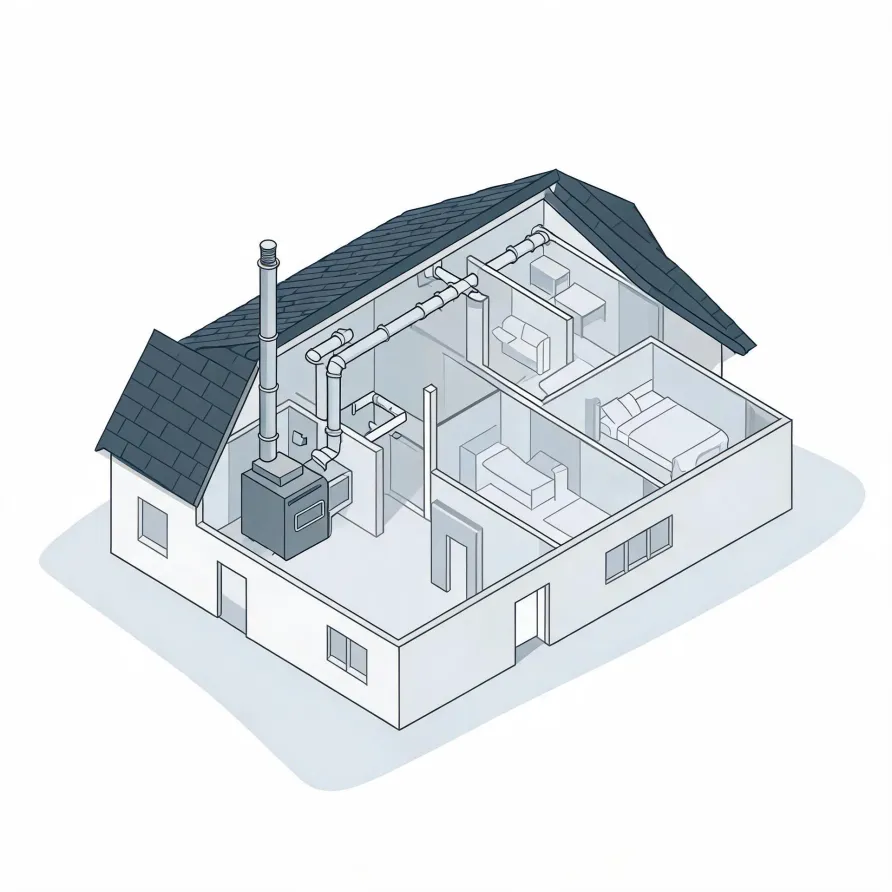
The furnace itself sits in a mechanical room, basement, or utility closet and is the heart of the system. Inside it, the heat exchanger, burners, and blower motor are the pieces a contractor looks at earliest when something goes wrong. A cracked heat exchanger, a failed igniter, or a seized blower motor each produces its own set of symptoms, and identifying which one is at fault is where a repair diagnosis begins.
The flue or vent pipe runs from the furnace up and out of the house, carrying combustion gases away. The thermostat sits on an interior wall and tells the furnace when to fire. The filter housing, usually right at the furnace's air intake, is a smaller piece that can quietly cause problems across the whole system when it is clogged.
The drawing shows a typical furnace layout, and a licensed contractor will determine which parts and conditions apply to your specific house.
Find a contractor in Waldo CountyWaldo County by the numbers
120 severe weather events were recorded in Waldo County, Maine between 2015 and 2024.
NOAA National Centers for Environmental Information, Storm Events Database, bulk CSV export, events 2015-01-01 through 2024-12-31.Half the homes in Waldo County, Maine were built in 1982 or earlier (2020-2024 ACS 5-year).
U.S. Census Bureau, 2020-2024 American Community Survey 5-Year EstimatesWaldo County, Maine holds 22,252 housing units (2020-2024 ACS 5-year).
U.S. Census Bureau, 2020-2024 American Community Survey 5-Year EstimatesOwners occupy 81.9% of the occupied homes in Waldo County, Maine (2020-2024 ACS 5-year).
U.S. Census Bureau, 2020-2024 American Community Survey 5-Year EstimatesCodes & Standards Governing Furnace Repair in Waldo County, Maine5 sourced rules and standards
What HVAC Repair Looks Like in Waldo County
Non-weatherized gas furnaces manufactured on or after November 19, 2015 must reach 80.0 percent AFUE.
Non-weatherized oil-fired furnaces manufactured on or after November 19, 2015 must reach 83.0 percent AFUE.
Mobile home gas furnaces manufactured on or after November 19, 2015 must reach 80.0 percent AFUE.
Non-weatherized gas furnaces manufactured on or after December 18, 2028 must reach 95.0 percent AFUE, up from the 80.0 percent minimum that applies to units manufactured before that date.
Licensing and Legal Requirements in Waldo County, Maine
Maine licenses the fuel-burning side of heating rather than HVAC as a trade: a Maine Fuel Board licence is required to install or service solid fuel, oil, propane or natural gas burning equipment, including pellet-fired central heating appliances. Air conditioning is not named anywhere in the chapter.
Severe Weather Events in Waldo County
Heating equipment in Maine works against the climate, not alongside it. How hard a furnace gets pushed over the years tracks closely with what the weather demands of it, which is why local storm history is part of the repair picture.
120 severe weather events, 2015–2024. Source: NOAA National Centers for Environmental Information, Storm Events Database.