Tell us about the job
Takes about a minute. No obligation.
A furnace repair in Penobscot County starts with the ignition system and the burner, because those are the parts that cycle every time the equipment fires. Homes in Penobscot County, ME run heat about nine months a year, from September through May. By the time a furnace shows a fault, the heat exchanger has flexed through hundreds of heating cycles, the igniter has fired across the full run of cold months, and the burner has accumulated the kind of carbon buildup that comes from sustained use. A contractor working a repair here opens those components first, prices what they find, and then looks at the secondary systems.
Furnaces in houses that have changed hands and heating systems more than once accumulate a repair history inside the cabinet that no exterior inspection reveals. Half the homes in Penobscot County, Maine were built in 1977 or earlier (2020-2024 ACS 5-year). That kind of stock sees contractors open a blower assembly expecting one problem and find evidence of several prior fixes, some done to spec and some not. A cracked heat exchanger in a house like this often sits alongside a blower wheel that was swapped at a different service call, wired to a control board from a third. The repair scope comes from what the opened unit actually contains, not from what the last owner remembered.
The Parts of a Furnace a Contractor Checks First
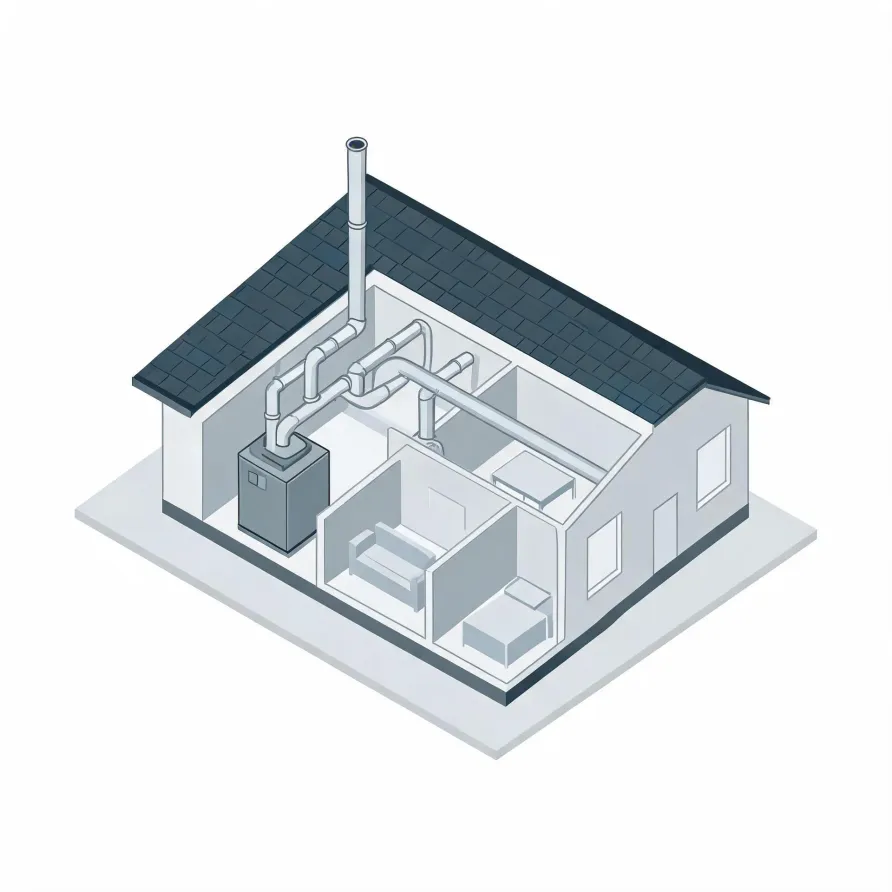
The furnace itself sits in a mechanical room, basement, or utility closet and is the piece a contractor goes to first when heat stops working. Inside it, the heat exchanger and burner assembly are the usual suspects when you have no heat or uneven heat. A cracked heat exchanger or a failed igniter shows up here.
The blower motor pushes conditioned air out through the supply side and sits inside the furnace cabinet, so a contractor checks it when airflow feels weak or the system runs but nothing moves. The flue or vent pipe carries combustion gases out of the house, and a blocked or separated section there is something a contractor traces when the furnace shuts itself off on a safety switch.
The drawing shows the general layout of a furnace system, and a licensed contractor determines what applies to your particular house.
Find a contractor in Penobscot CountyPenobscot County, by the numbers
369 severe weather events were recorded in Penobscot County, Maine between 2015 and 2024.
NOAA National Centers for Environmental Information, Storm Events Database, bulk CSV export, events 2015-01-01 through 2024-12-31.Half the homes in Penobscot County, Maine were built in 1977 or earlier (2020-2024 ACS 5-year).
U.S. Census Bureau, 2020-2024 American Community Survey 5-Year EstimatesPenobscot County, Maine holds 75,683 housing units (2020-2024 ACS 5-year).
U.S. Census Bureau, 2020-2024 American Community Survey 5-Year EstimatesOwners occupy 70.5% of the occupied homes in Penobscot County, Maine (2020-2024 ACS 5-year).
U.S. Census Bureau, 2020-2024 American Community Survey 5-Year EstimatesCodes & Standards Covering Furnace Repair in Penobscot County, Maine5 sourced rules and standards
What HVAC Repair Looks Like in Penobscot County
Non-weatherized gas furnaces manufactured on or after November 19, 2015 must reach 80.0 percent AFUE.
Non-weatherized oil-fired furnaces manufactured on or after November 19, 2015 must reach 83.0 percent AFUE.
Mobile home gas furnaces manufactured on or after November 19, 2015 must reach 80.0 percent AFUE.
Non-weatherized gas furnaces manufactured on or after December 18, 2028 must reach 95.0 percent AFUE, up from the 80.0 percent minimum that applies to units manufactured before that date.
Licensing and Legal Requirements in Penobscot County, Maine
Maine licenses the fuel-burning side of heating rather than HVAC as a trade: a Maine Fuel Board licence is required to install or service solid fuel, oil, propane or natural gas burning equipment, including pellet-fired central heating appliances. Air conditioning is not named anywhere in the chapter.
Weather Stress on HVAC Equipment in Penobscot County
Heating equipment in Penobscot County works against whatever the weather demands of it, and that demand is not the same everywhere. A furnace repair history is partly a weather history, which is why local storm data belongs alongside a conversation about keeping heating systems in working order.
369 severe weather events, 2015–2024. Source: NOAA National Centers for Environmental Information, Storm Events Database.